Hadad and Haddad: Meaning, Origin, Surname History and Ancient Background
A detailed research guide to the Arabic word Haddad, its connection with ironworking, the Haddad family name, spelling variations, the ancient Near Eastern storm god Hadad, biblical references, geographical distribution and the challenges of family-history research.
- What does Haddad mean?
- Arabic roots and pronunciation
- The historical blacksmith
- Haddad as a family name
- Haddad, Hadad and spelling variants
- The name across communities
- Hadad in the ancient Near East
- Hadad and Baal
- Hadad in biblical texts
- Haddad in Iran and Khorasani research
- Geographical distribution
- How to research a Haddad family
- Understanding searches for Hadad and Haddad
- Frequently asked questions
- Sources and further reading
1. What Does Haddad Mean?
Haddad is most commonly understood as an Arabic occupational word meaning a blacksmith or ironsmith. It refers to a craftsperson who works with iron: heating it, hammering it, shaping it, cutting it, repairing it or turning it into useful objects. In English, “blacksmith” is generally the most familiar equivalent, while “ironsmith” is another close translation.
The meaning is important because many family names developed from occupations. In societies where a person's profession was a major part of their public identity, a blacksmith might be known by the name of his trade. Over time, that occupational label could become hereditary and remain a family name even after later generations entered different professions.
The word should be understood in context. A dictionary entry, a historical text and a modern surname record do not necessarily use a word in exactly the same way. A historical dictionary may preserve older meanings or specialized occupational references that are no longer common in everyday speech. When a reader encounters Haddad in a poem, document or family record, the surrounding sentence and the date of the source matter.
Blacksmith, ironsmith and metalworker
These English words overlap, but they are not perfectly interchangeable. A blacksmith traditionally works with iron or steel, often heating the metal in a forge and shaping it with a hammer and anvil. An ironsmith emphasizes iron as the material. A metalworker is broader: it may refer to someone working with several metals or using processes that are not part of traditional blacksmithing.
For the Arabic surname Haddad, “blacksmith” is a useful concise explanation. “Metalworker” can be used in a broader discussion, but it may lose the occupational specificity of the original term.
2. Arabic Roots, Structure and Pronunciation
In Arabic, حديد (ḥadīd) means iron, while حدّاد (ḥaddād) refers to a blacksmith or ironsmith. The words belong to a related lexical field associated with iron and metalworking. The consonantal root commonly discussed in connection with these forms is ḥ-d-d.
The Arabic spelling of the occupational word is often shown with a shadda over the letter dāl: حدّاد. The shadda indicates consonant doubling. In a more technical Latin transliteration, the word may be represented as ḥaddād, using a dot-under h to distinguish the Arabic consonant from an ordinary English h and a macron to indicate a long vowel. In everyday international spelling, the simpler form Haddad is much more common.
Different transliteration systems can produce different spellings of the same spoken name. A family document may use Haddad, another may use Al-Haddad, and a later immigration record may omit a prefix or simplify a doubled consonant. These changes do not automatically indicate a different family, but neither do they prove that two records belong to the same family. Each spelling must be evaluated alongside dates, places and personal details.
| Written form | Context | Explanation |
|---|---|---|
| حدّاد | Arabic | The occupational word, commonly meaning blacksmith. |
| حديد | Arabic | Iron; a related word in the same semantic field. |
| ḥaddād | Scholarly transliteration | A more precise representation of the Arabic pronunciation. |
| Haddad | Common Latin spelling | A widely used spelling for the occupational word and surname. |
| Hadad | Historical and personal name | A form associated with ancient Near Eastern religious and personal names. |
Why spelling matters in family history
Historical records are not always consistent. A clerk might write a name according to local pronunciation; a family might adopt a spelling that is easier to use in another language; or a prefix might be joined to or separated from the rest of the name. For genealogical research, it is therefore sensible to search several spelling variants rather than assuming that one modern spelling was used in every generation.
3. The Blacksmith: A Profession Behind the Name
Blacksmithing was one of the essential crafts of pre-industrial communities. A blacksmith's workshop could serve farmers, builders, merchants, transport workers, soldiers and ordinary households. The craft required more than physical strength. A skilled smith needed to understand how metal responded to heat, how long it should remain in the fire, when it was ready to be hammered, how to shape it without damaging it and how to finish the object so that it would work reliably.
Tools and the working environment
A traditional forge commonly included a fire or furnace, fuel, a bellows or another air-supply mechanism, an anvil, hammers, tongs and tools for cutting and finishing metal. The forge provided heat; the anvil provided a stable surface; the hammer shaped the heated material; and the tongs allowed the smith to hold hot metal safely. Different objects required different techniques and tools.
Blacksmiths produced and repaired a wide range of objects. Agricultural communities needed durable blades, hoes, sickles, plough components and repair parts. Buildings required nails, hinges, brackets, locks and other fittings. Households used metal tools and hardware. Transport systems relied on metal components for carts, wagons and animal equipment. Weapons were part of the craft in some contexts, but they were only one category among many.
Why the profession mattered economically
A village or town could depend on a local blacksmith because many everyday activities required metal tools. When a blade broke or a hinge failed, repair could be more practical than replacing the entire object. The blacksmith therefore occupied a position within a network of local trades and services. The workshop was not merely a place where metal was shaped; it was part of the practical infrastructure of a community.
Skills were often acquired through long practical training. An apprentice learned to recognize heat, control the hammer, prepare materials and complete increasingly complex work. The craft's knowledge was embodied in practice, observation and repetition. This professional identity could become socially recognizable enough for the occupational term to function as a nickname or family designation.
From occupation to inherited surname
Occupational surnames developed in many languages. A person might be identified by the work he performed, the goods he produced or the service he provided. Over generations, the occupational label could become a stable family name. Descendants might continue the trade, move into other occupations or migrate to another region while retaining the inherited surname.
This process explains why the meaning of a surname does not necessarily describe the occupation of every person who carries it today. A modern Haddad may be a teacher, engineer, artist, business owner or researcher. The surname can preserve a historical occupational association without describing the person's present-day work.
4. Haddad as a Family Name: Origin and Historical Use
Haddad is widely described in surname references as an Arabic occupational surname meaning blacksmith or ironsmith. It is found across different regions and communities, particularly in areas connected by Arabic-speaking history, trade, migration and cultural exchange. The presence of the name in more than one religious community is an important part of its history.
Family-history references such as FamilySearch describe Haddad as an occupational name associated with blacksmithing. The ANU Museum of the Jewish People also records forms including HADAD, HADDAD and AL-HADDAD. Its surname material discusses more than one possible historical explanation, including an occupational derivation and, in some cases, a connection with the personal name Hadad.
These explanations should not be collapsed into one universal family origin. A surname can arise independently in different places. Two unrelated families may acquire the same occupational name because members of both families worked as blacksmiths. Another family may inherit a similar-looking name from a personal ancestor or a local naming tradition. A shared spelling is not proof of a shared genealogical line.
Common spelling forms
| Form | Possible background | Research caution |
|---|---|---|
| Haddad | Common Latin spelling of the Arabic occupational name. | Does not establish that all bearers are related. |
| Al-Haddad | Form including the Arabic definite article al-. | Prefixes may be joined, separated or omitted in records. |
| Elhaddad | A recorded spelling variant in some family histories. | Local pronunciation and record history should be checked. |
| Alhadad | A spelling form found in some records and databases. | Could reflect transliteration or administrative variation. |
| Ben Alhadad | A historical family-name form documented in Jewish contexts. | A historical occurrence does not prove a modern family's descent. |
| Haddadin | A related-looking form found in some naming traditions. | Its relationship to a particular Haddad family requires evidence. |
Occupational origin or descent from a person named Hadad?
The occupational explanation is common for Haddad. However, surname references also preserve other possible historical paths in particular communities. The ANU Museum's material notes that Hadad may appear as a patronymic connected with a personal name of biblical origin, as well as an occupational name related to blacksmithing. These possibilities concern different historical mechanisms.
A patronymic is a name derived from a father, ancestor or personal name. An occupational surname is derived from a trade or profession. The same or similar spelling can therefore have more than one origin. The correct explanation for an individual family depends on its earliest reliable records and the local naming history.
5. Hadad vs. Haddad: Why the Difference Matters
The difference between Hadad and Haddad may look minor in Latin letters, but it matters in historical and linguistic research. Haddad is commonly associated with the Arabic occupational word for a blacksmith. Hadad is a well-known form in ancient Near Eastern studies, where it is associated with a storm deity and appears in historical personal names.
It would be a mistake, however, to assume that every modern record follows a perfectly consistent spelling system. In immigration documents, civil registers, commercial records and family papers, names can be simplified or altered. A doubled consonant may disappear, a prefix may be attached, and a name may be written according to the spelling habits of another language.
How to investigate a spelling variation
Begin with the original document whenever possible. Record the exact spelling, date, place, language and type of document. Compare the spelling with other records for the same individual. Look for consistent details such as parents' names, spouse, occupation, village, age and migration route. A spelling match is useful, but a combination of independent identifiers is much stronger evidence.
6. Haddad Across Different Communities
Haddad appears in records connected with different Arabic-speaking communities, including families with Muslim and Christian backgrounds. This is consistent with the occupational nature of the name. Blacksmithing was a practical profession found across religious and regional boundaries, and occupational labels could become family names in different communities independently.
The name is also documented in some Jewish family histories, including material relating to North African and Yemeni Jewish communities. The ANU Museum of the Jewish People records forms such as Hadad, Haddad and Al-Haddad and discusses particular family traditions. Its material refers to Moroccan chronicles that mention a family of cohanim associated with the name, as well as Jewish families from Yemen.
The museum's account also notes that many Hadad families who immigrated from Yemen to Israel during the 1950s changed their name to Barzelai, a Hebrew form associated with iron. This is an example of a broader phenomenon in migration history: family names can be translated, adapted, shortened or replaced when families move into a new linguistic and administrative environment.
Such records are valuable, but their scope must be respected. Evidence for one Moroccan family does not describe every Moroccan Haddad family. A record of the name among Yemeni Jews does not prove that every Haddad family in Yemen shared the same ancestry. Community history and individual genealogy are related fields, but they answer different questions.
Migration and the changing form of a name
Migration can create multiple spellings for the same family. A name may be transliterated into French, English, Hebrew, Persian or another language. Some families retain the original form; others choose a local spelling or a translated equivalent. In later generations, the adapted spelling may become the family's official identity even if older documents preserve another form.
For researchers, this means that searching only one spelling may miss relevant records. A careful search should include likely variants, local scripts and the languages used by the institutions that produced the documents.
7. Hadad in the Ancient Near East: The Storm God
In ancient Near Eastern religious history, Hadad is a significant name associated with a storm deity in West Semitic traditions. Related forms in ancient sources include Haddu, Hadda, Adad and Addu. In Sumerian contexts, the storm god is associated with the name Iškur. In Hurrian and Hittite religious settings, other storm deities, including Teššub and Tarhunza, appear in their own linguistic and cultural traditions.
These figures should not be treated as interchangeable names without qualification. Ancient cultures interacted, shared symbols and sometimes identified one deity with another. Yet each tradition had its own texts, local cults, political setting and religious vocabulary. A name's meaning and role must be interpreted in the context of the inscription or literary source in which it appears.
Rain, thunder and agricultural life
In regions where agriculture depended on seasonal rainfall, the storm deity could occupy a central position. Rain was necessary for crops, pasture and the renewal of the landscape. At the same time, destructive storms, floods and drought could threaten settlements and harvests. The storm god therefore represented both the life-giving and dangerous power of the natural world.
Hadad could be associated with thunder, lightning, rain, fertility and the protection of a territory. In some Aramaean royal traditions, the deity also played a role in royal ideology. A king's authority could be expressed through a relationship with the god who protected the city or kingdom. Religious symbolism and political legitimacy were therefore sometimes closely connected.
Ancient imagery and symbols
Storm deities in the ancient Near East were represented in different ways across periods and regions. Images could include a thunderbolt, a weapon, a bull, a chariot or a powerful standing figure. The bull could express strength and fertility, while lightning represented command over the storm. These motifs were not uniform in every culture, and an image should be identified through archaeological context rather than resemblance alone.
Ancient iconography is especially important because written names and visual symbols do not always appear together. A researcher may need to consider the location of an object, its date, its inscription, the artistic style and the broader religious tradition before assigning it to a particular deity.
Hadad, Adad and related names
Scholarly literature discusses a range of forms, including Hadad, Haddu, Hadda, Adad and Addu. Their relationship is a subject of historical linguistics and the study of ancient religion. The forms may reflect language differences, local pronunciation, scribal conventions or the transmission of religious traditions between neighboring societies.
Research on Hadad in Aramaean Syria emphasizes that the deity was not necessarily represented identically in every city or kingdom. Local manifestations could have distinct traditions, political roles and cultic characteristics. This is a useful reminder that ancient religious names should not be reduced to a single simplified definition.
8. Was Hadad the Same as Baal?
Hadad is associated with the title or designation Baal in some ancient Levantine contexts. The Semitic word baal can mean “lord” or “master” and could function as a title in religious and social settings. In certain traditions, the storm deity is described through forms such as Baal-Hadad.
That association does not mean that every occurrence of Baal in every ancient text refers specifically to Hadad. The term had a wider history and could be used in different local and religious contexts. The meaning of a particular occurrence depends on the language, date, place, inscription or literary tradition involved.
When reading a historical source, it is therefore better to ask whether the text explicitly identifies a deity, uses Baal as a title, refers to a local divine figure or reflects a later interpretation. This avoids treating a complex religious history as if it were a single unchanging system.
9. Hadad in Biblical Texts and Historical Personal Names
Hadad appears in biblical and related historical discussions as a personal name and as an element in compound names. Examples include Ben-Hadad, associated with Aramaean kings, and Hadadezer, a name found in accounts concerning rulers of the region. Hadad also appears in genealogical lists.
These occurrences need to be distinguished from references to the deity itself. A personal name can preserve a divine element or reflect a cultural naming tradition without making every person who bears it identical in status or religious role. A royal name, a genealogical name and a divine name are related categories of evidence, but they are not the same kind of evidence.
Some scholarly and reference works discuss textual variants, including readings in which Hadad and Hadar differ. Such variations matter for textual criticism and the interpretation of ancient manuscripts. They should not be used as a shortcut to establish the ancestry of a modern family.
Compound names and theophoric elements
A theophoric name is a personal name that includes the name of a deity or a reference to divine protection. Such names were common in several ancient Near Eastern cultures. They can provide evidence about religious language, political identity and naming customs, but they must be interpreted within their historical setting.
For example, the presence of a divine element in a royal name may reflect a political or religious tradition associated with a kingdom. It does not automatically demonstrate that every later person with a similar name belonged to the same dynasty or community.
10. Haddad in Iran and the Question of Khorasani Haddad Families
In Persian-speaking contexts, حداد may be encountered as a word related to ironworking or as a family name. Iranian surnames can reflect occupations, places, ancestors, titles, local identities and administrative naming practices. The meaning of a surname can provide a useful starting point, but it cannot by itself establish the history of a particular Iranian family.
What does “Khorasani Haddad” refer to?
The expression “Khorasani Haddad” may be used in searches to refer to a particular family, a local branch, an individual, a regional identity or a combination of surname and geographical designation. To describe it as a documented historical lineage, however, researchers need identifiable records. The existence of the surname in Khorasan, or the presence of individuals with that surname in the region, is not enough to prove a single common ancestor.
A serious investigation should begin with the oldest verifiable family records available. These may include civil registration documents, marriage records, property deeds, endowment documents, cemetery inscriptions, local histories, migration records, family correspondence and dated documents preserved by relatives. Each record should be assessed for its date, origin, reliability and relationship to the people being studied.
Oral history can be valuable, especially when it preserves village names, occupations, migration routes and the names of earlier generations. But oral accounts should be recorded carefully and compared with independent evidence. A family story may preserve an important clue while still containing chronological gaps or later reinterpretations.
If a family tradition says that an ancestor was a blacksmith, this may support the occupational interpretation of the surname. It does not prove that every family named Haddad descends from one blacksmith, nor does it establish a connection with the ancient storm deity. Similarly, a family's association with Khorasan may describe a recent residence rather than its oldest known origin.
11. Geographical Distribution of the Haddad Surname
Haddad is recorded in surname databases across several countries, particularly in the Middle East and North Africa. Its distribution reflects long histories of Arabic-speaking communities, regional trade, migration and the adoption of occupational surnames. The name is also found outside those regions as a result of later migration.
Forebears provides estimated surname-distribution data for Haddad. A dataset identified with the year 2014 estimated approximately 267,000 bearers worldwide and listed countries such as Algeria, Saudi Arabia, Syria, Lebanon, Iran, Jordan, the United States, Morocco and Egypt among the places with notable numbers of people recorded under the name.
These figures should be treated as estimates from a surname database, not as an official census or a current population count. Database coverage, spelling variations, the availability of records and the date of collection can all affect the results. The year attached to the dataset matters: a 2014 estimate should not be presented as a verified count for the present year.
What surname maps can and cannot tell us
A distribution map can help researchers identify places where a name has been recorded and suggest possible regions for further investigation. It cannot prove the origin of an individual family. A large number of Haddad records in a country does not mean that every Haddad family in that country shares a common ancestor or belongs to the same historical community.
Geographical patterns should therefore be combined with local records, historical migration evidence, language history and family documents. The map is a research clue, not a genealogy.
12. How to Research the History of a Specific Haddad Family
Researching a family named Haddad requires a different method from researching the general meaning of the surname. Etymology can explain why a name may have developed, but genealogy must establish the relationships between actual people. The strongest approach is to begin with known relatives and work backward through documented generations.
Step 1: Collect every spelling found in records
Record all forms used by the family, including Haddad, Hadad, Al-Haddad, Elhaddad and local-script spellings. Do not silently standardize the documents. Preserve the original spelling, date, place, language and issuing authority. A variation may reflect transliteration, a clerical error, a family decision or a genuine distinction between branches.
Step 2: Build a generation-by-generation family table
For each person, record the full name, parents, spouse, approximate birth and death dates, locations, occupation and the source supporting each detail. If a date is uncertain, mark it as an estimate rather than presenting it as a fact. Every parent-child connection should be supported by a record or by several independent pieces of evidence.
Step 3: Search local and civil records
Useful materials may include birth and death registrations, marriage records, land documents, tax records, endowment deeds, cemetery inscriptions, local newspapers, court documents, school records, military records and immigration files. The availability of these sources varies by country and historical period.
Local place names are especially important. A family may have moved between a village, a regional city and a larger commercial center without changing its surname. Mapping these movements can help researchers distinguish a place of recent residence from an older family origin.
Step 4: Treat oral history as evidence to investigate
Interview older relatives separately when possible. Ask for names, approximate dates, places, occupations, migrations and the sources of particular stories. Record differences between accounts rather than forcing them into one version. Oral history is often most useful when it points toward a document, cemetery, village or person that can be independently checked.
Step 5: Use genetic genealogy carefully
DNA testing can help identify possible biological relationships and connect researchers with genetic matches. It cannot, on its own, prove that two families with the surname Haddad share a documented historical ancestor. Genetic matches need to be interpreted alongside family trees, records, geography and the limits of the testing method.
A responsible genealogy distinguishes confirmed facts, strong hypotheses and unverified family traditions. That distinction makes a family history more credible, not less interesting.
13. Understanding Searches for Hadad and Haddad
People searching for “Hadad” or “Haddad” may have very different questions. One visitor may want the Arabic meaning; another may be researching a surname; another may have encountered Hadad in an ancient text; and another may be investigating a particular family. A useful reference page should answer these related questions without confusing them.
| Search phrase | Likely search intent | What a useful answer should cover |
|---|---|---|
| Hadad | General name or historical reference. | Explain the different historical and linguistic uses. |
| Haddad | Surname or occupational word. | Explain the blacksmith meaning and surname history. |
| Haddad meaning | Definition and translation. | Give the Arabic meaning, pronunciation and context. |
| Haddad surname origin | Family-name etymology. | Discuss occupational origin and alternative documented paths. |
| Hadad ancient god | Ancient religion and mythology. | Explain the storm deity and distinguish regional traditions. |
| Hadad in the Bible | Religious and historical texts. | Identify personal names and relevant textual contexts. |
| Khorasani Haddad | A regional family-history question. | Explain what evidence is needed to establish a lineage. |
Search optimization should reflect these genuine differences in user intent. A page about the surname should not repeat the same keyword mechanically. It should use meaningful related phrases where they help the reader: Arabic occupational surname, blacksmith, ironsmith, family-name origin, spelling variants, ancient Near Eastern storm god, biblical personal names and genealogical research.
For an English-language page, phrases such as Haddad surname origin, Haddad family name, Hadad meaning, Hadad storm god and Arabic word for blacksmith can appear naturally in headings and explanations. Their value comes from the information they help organize, not from repeated insertion.
14. Frequently Asked Questions About Hadad and Haddad
What does Haddad mean in Arabic?
Is Haddad an Arabic surname?
What is the difference between Hadad and Haddad?
Are all people named Haddad related?
Was Hadad an ancient god?
Was Hadad the same as Baal?
Does Haddad have a Jewish family history?
Is there a verified Khorasani Haddad dynasty?
How can I find my Haddad family origin?
Does Haddad always mean blacksmith?
Is Hadad a biblical name?
Can a surname prove descent from an ancient king?
15. Sources and Further Reading
The study of Haddad and Hadad crosses several academic fields. Arabic lexicography is useful for the occupational meaning; surname references help explain naming patterns; museum and archival resources document particular communities; and ancient-history scholarship examines the storm deity. Search-engine documentation is relevant to the publication of multilingual versions of this article, not to the historical meaning of the name.
- ANU Museum of the Jewish People — surname database, including the Haddad entry and historical forms recorded in some Jewish communities.
- FamilySearch — surname and genealogy resources for researching family-name history.
- Jewish Encyclopedia: Hadad — a historical reference entry discussing Hadad as a storm deity and its use in personal names.
- Lexham Bible Dictionary — reference material for biblical and ancient Near Eastern names.
- Forebears: Haddad — estimated surname distribution. Its figures should be cited with the relevant dataset year and methodological limitations.
- Google Search Central: Managing Multilingual Sites — guidance on separate language URLs and helping search engines identify language versions.
- Google Search Central: Title Links — official guidance on descriptive and concise page titles.
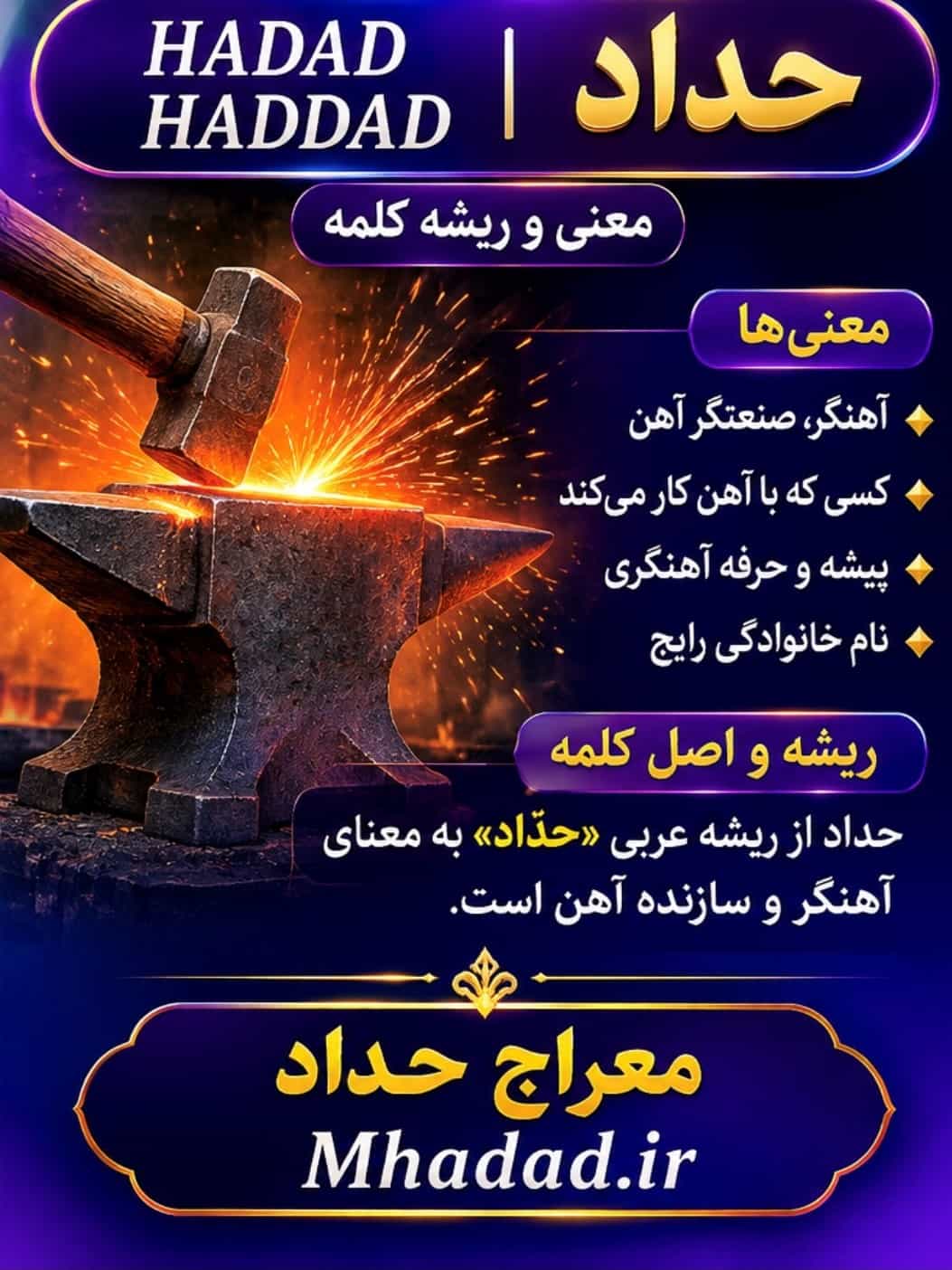
Explore the linguistic roots, historical background and meaning of Hadad, including its connection with traditional terminology.
نویسنده و گردآورنده مطالب سایت mhadad.ir